GPU risk engine · Zero data egress · Privacy-safe synthetic data

Your overnight VaR run, in minutes.

Proven on your data, inside your perimeter, in six weeks.

QSyn is a GPU-accelerated risk engine for Monte Carlo VaR and ES, credit, liquidity and portfolio optimization. It runs on your infrastructure and plugs into Python. Your positions, deals and weights never leave your data warehouse — you bring the compute to your book, not your book to a vendor. When a team needs data it isn't allowed to touch, QSyn-Data generates privacy-safe synthetic sets for the same pipeline.

The simulation on this page is running in your browser right now. Download the notebook and check our math. No email required.

Engine targets, measured in every pilot
≥50M
MC paths / sec on one GPU
<30 s
Market VaR job, full book
pip install
Python SDK, Jupyter-first
On-prem
zero egress — your book never leaves
10-day 99% VaR · $10M book ready

Monte Carlo simulation of a ten-million-dollar portfolio over ten trading days. Results appear when the simulation finishes.

Paths
1,000,000
× 10 daily steps
99% VaR
—
analytic —
99% ES
—
analytic —
Time
—
1 CPU thread

Reference model: GBM, σ 20%/yr, seeded and reproducible. This is the CPU baseline, not the GPU engine. Hover the chart to read the percentiles.

Notebook
The problem

Four things stall every risk and AI program in finance.

QSyn is built to remove all four, starting with the one your quants feel every night.

01 · SPEED

Overnight is too slow

Monte Carlo, CVaR and XVA stacks built on 1990s architecture turn intraday questions into next-day answers.

02 · SOVEREIGNTY

Your book has to leave the building

To use a vendor's models you ship your positions, deals and weights into their cloud — creating egress, reconciliation and lock-in you can't undo.

03 · PRIVACY

The data can't move

GDPR, DORA and banking-secrecy rules keep real customer and transaction data away from the teams that need it.

04 · GOVERNANCE

Every model needs proof

Reproducibility, lineage and model-risk sign-off (SR 11-7) are mandatory, and usually bolted on after the fact.

The platform

Start with speed. Expand into the loop.

Most teams begin with the risk engine their quants can benchmark this quarter. The synthetic-data engine is the natural next step, and the two feed each other.

QSyn-Risk Start here

GPU-accelerated risk engine

A C++/CUDA simulation core that runs alongside, or replaces, your legacy risk stack, driven from Python.

Best for: trading, risk and quant research desks

  • Market risk: Monte Carlo, historical and delta-gamma VaR, CVaR and Expected Shortfall at GPU scale.
  • Credit & liquidity: Merton and reduced-form models, Gaussian-copula correlation, PD/LGD/EAD, time-to-liquidate curves.
  • Optimization: mean-variance, Black-Litterman and CVaR-constrained portfolios.
  • Quantum-ready: optional QUBO/QAOA backends, always benchmarked against a classical solve.
QSyn-Data Expansion

Synthetic data platform

High-fidelity, privacy-safe datasets for research, model training and testing, without exposing a single real record.

Best for: fintech, regtech and bank data teams

  • Generators: CTGAN, diffusion, TVAE, transformers, and GNNs for transaction networks.
  • Finance-native types: tabular banking, event streams, time series, order books, fraud graphs, exposures.
  • Differential privacy: (ε, δ) calibration, DP-SGD, membership- and attribute-inference tests, re-ID scoring.
  • Model training & validation: Train and validate models on synthetic data — develop, test and stress models without touching restricted data, then confirm on real data with train-on-synthetic, test-on-real (TSTR) scoring.
  • Evidence: a versioned utility and privacy report for every dataset.

Privacy, enforced

Per-dataset (ε, δ) budgets and re-identification scoring; exports are blocked automatically when risk reads HIGH.

Reproducible by default

Deterministic seeds; every job logs scenario, dataset lineage and model config to an immutable store.

Deploys where data lives

Runs on-prem, in your own cloud account (VPC), or hybrid across the two. Your proprietary data stays in your DWH — no vendor round-trip to reconcile, nothing to un-lock-in later. Zero data exfiltration by design. Security overview

Governance you can sign off

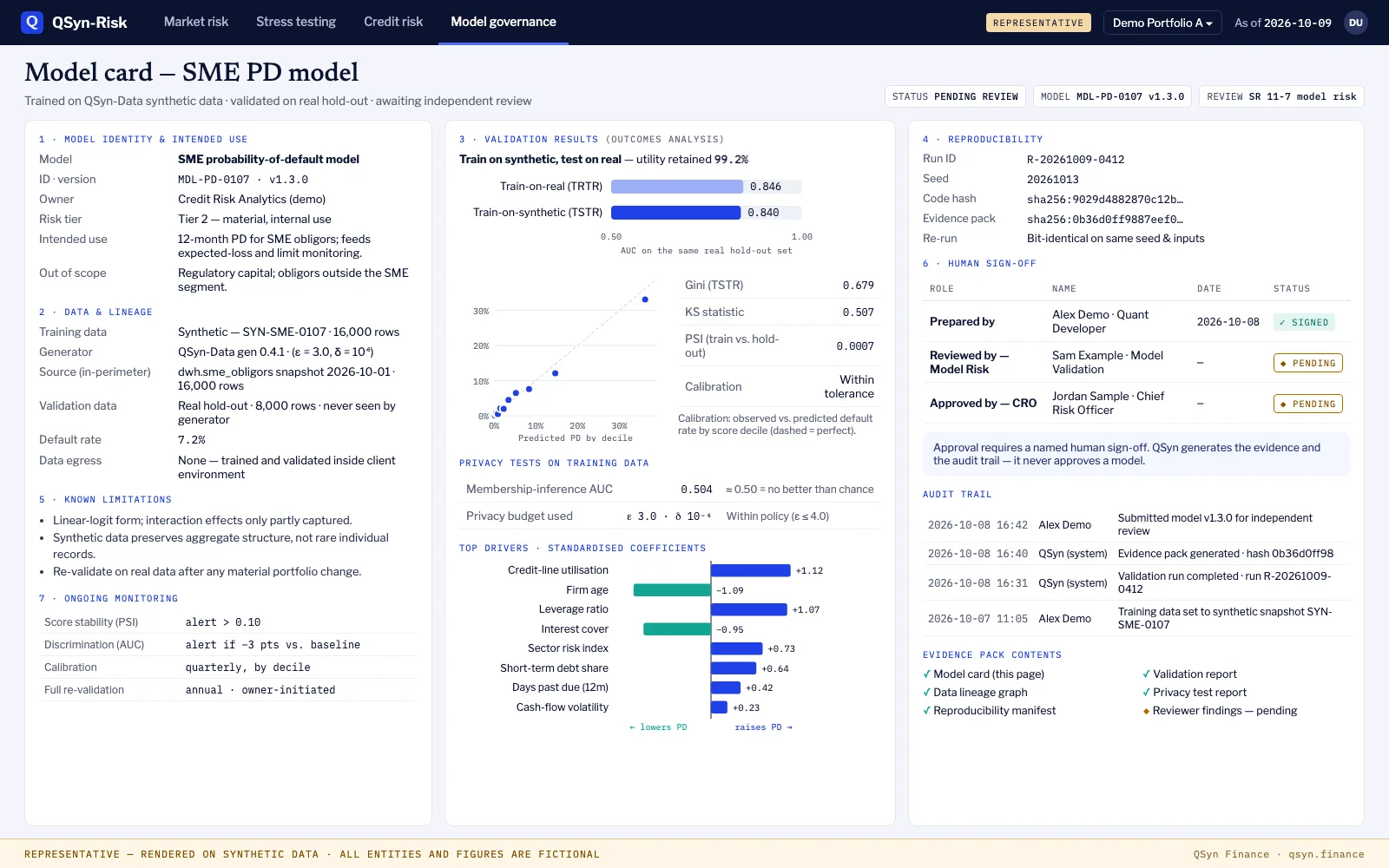
Every run produces the evidence model risk asks for: model cards, dataset lineage, immutable audit logs and seeded, reproducible results — packaged as an evidence pack for your SR 11-7 model-risk review. QSyn produces the evidence and the trail; your people keep the sign-off.

Governance stays human — no automated approvals.

Why both engines

A closed loop that sharpens with every run.

Each lap, the risk engine finds where losses concentrate and sends those tail scenarios back to the synthetic-data engine, so the next training set covers stress that history barely recorded. Point tools cover one arc of this loop. Press play, or pick a stage.

Step 1 of 3 · QSyn-Data

Synthetic data

In
your real data, which stays inside your perimeter
Out
a privacy-safe synthetic training set

QSyn-Data learns the shape of your data under a differential-privacy budget and generates a synthetic set that matches it.

Real data (never leaves) Synthetic set Stress scenarios from the risk engine Forecast 99% loss threshold
Lap
1 of 4
Tail scenarios in training set
—
Real records shared
0

Illustrative model: 1,000 days of simulated returns, with a simple kernel generator standing in for QSyn-Data's privacy-safe models. It shows the mechanism, not a benchmark.

Data sovereignty

Your data never leaves.

The smarter architecture isn't shipping your whole book to a vendor to use their data — it's keeping your proprietary data (positions, deals, weights, private-market commitments) inside your own DWH, and bringing the compute to it. QSyn runs inside your environment; you still consume the vendors' published data, you just stop exporting your crown jewels to get it.

With QSyn With QSyn: your book of positions, deals, weights and private-market commitments and the QSyn engine both sit inside your environment (DWH or VPC). The compute points at the data, vendor published data flows in, and your book never leaves. vendor published data YOUR ENVIRONMENT · DWH / VPC positions deals weights private-market commitments compute zero egress Your book QSyn engine
Compute comes to the data → your book never leaves
The old way The old way: your book of positions, deals and weights leaves your firm for a separate vendor cloud, creating egress, reconciliation and lock-in. YOUR FIRM positions deals weights leaves ! Your book Vendor cloud
Your book leaves → egress · reconciliation · lock-in

No egress

Your data stays in your perimeter.

Nothing to reconcile

No vendor round-trip.

No lock-in

It's your environment, your data.

Security overview →
Performance

Engineering targets, and how we'll prove them.

These are the speedups the engine is designed to hit against a CPU baseline. They stay labeled as targets until they're measured, and in a pilot they're measured on your workload.

Target speedup vs. CPU baseline

one linear axis · bar = target range
Monte Carlo path generationmarket VaR / ES
20–50×
CVaR-constrained optimizationportfolio construction
10–20×
Scenario generationregulatory & custom shocks
5–10×
Synthetic model trainingGPU vs. CPU
3–5×
Target range 1× = CPU baseline

Every published number states

  • Hardware: exact GPU and CPU models
  • Baseline implementation and library versions
  • Problem size: paths, steps, factors, instruments
  • Precision (fp32 / fp64) and error vs. baseline
  • Wall-clock including data transfer
  • A notebook you can re-run yourself

Check the math now

Download the reference notebook: the same 10-day VaR model that's running in the hero, in plain NumPy with an analytic cross-check. It's the CPU baseline our GPU numbers will be measured against.

Download notebook (.ipynb)
No email · NumPy only · runs in about a second
See the output

The reports your risk committee actually reads.

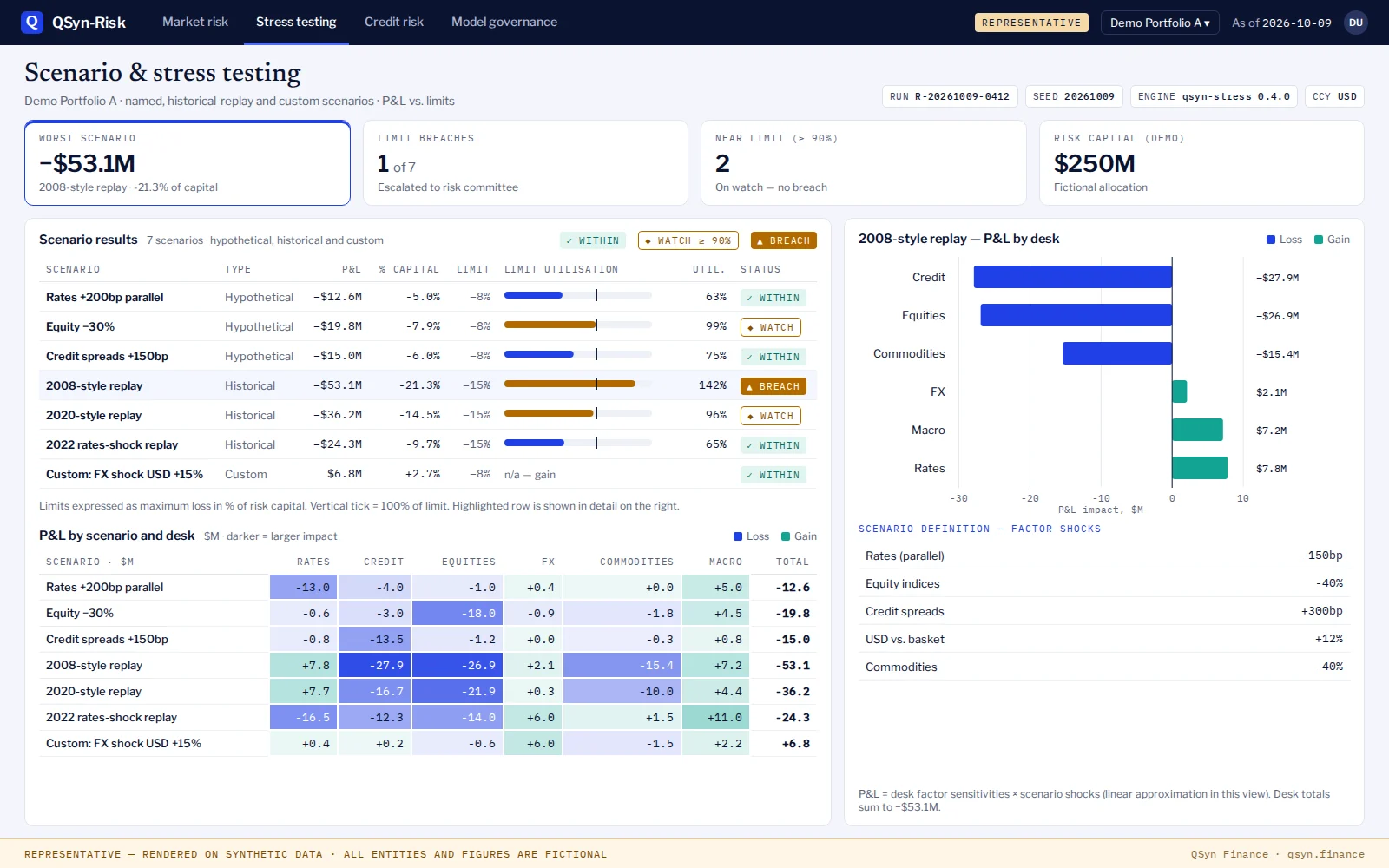
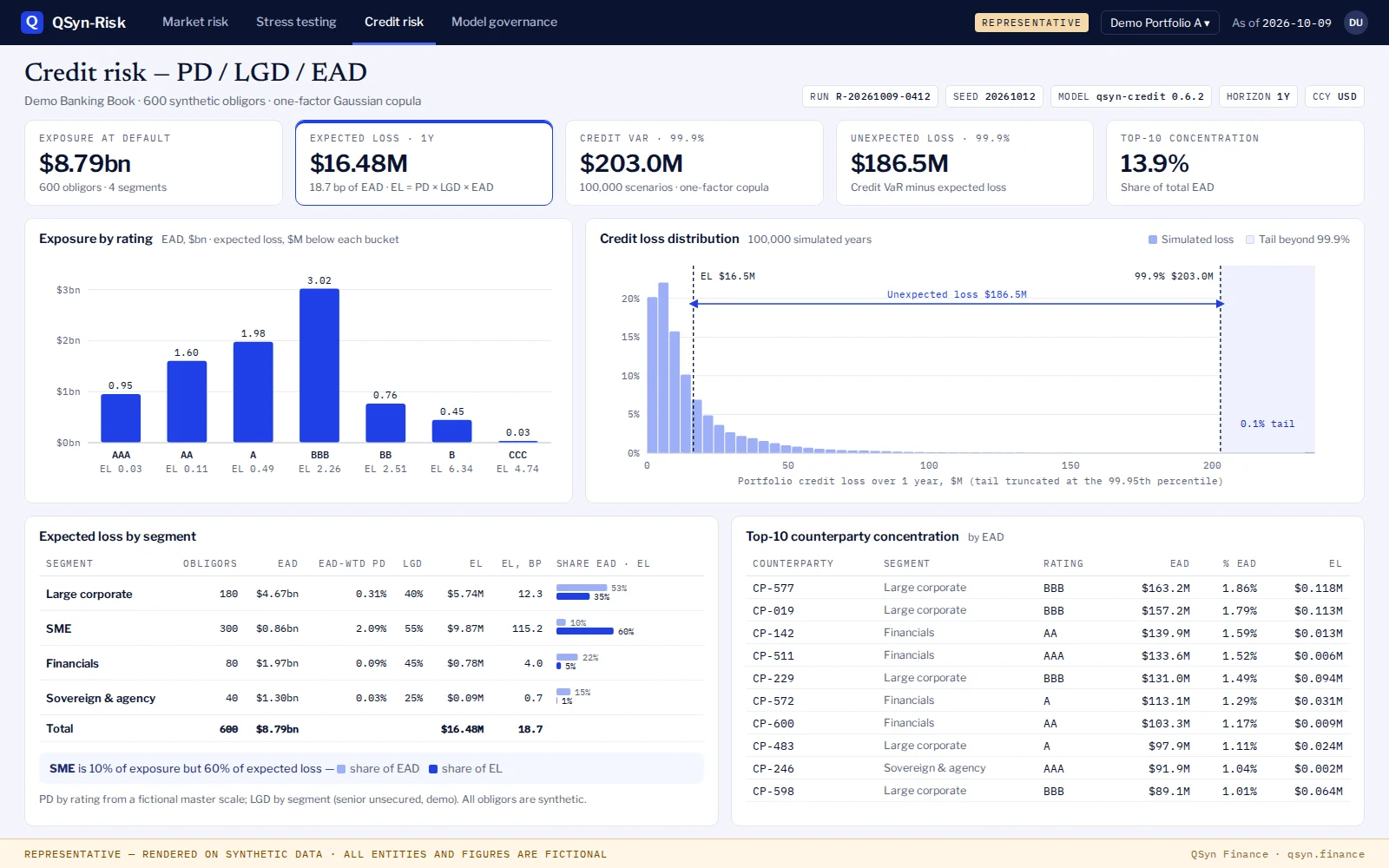
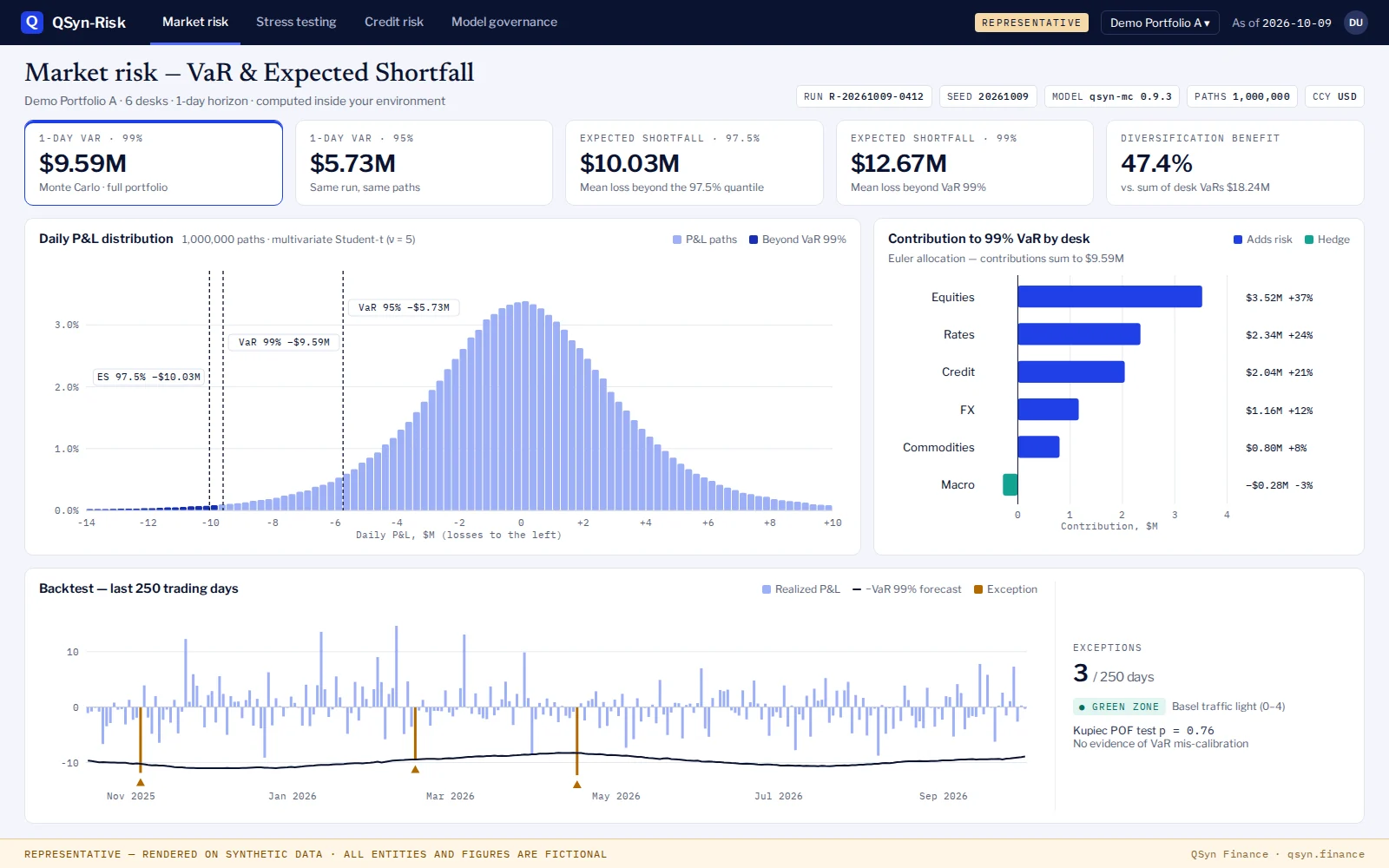
VaR and Expected Shortfall, stress scenarios, credit loss and a model card with a human sign-off trail — from one engine, on your book, inside your environment.

RepresentativeRepresentative screens rendered on synthetic data. Your pilot produces these on your own book.

    Open the representative reports (synthetic data): Market risk · Stress testing · Credit risk · Model card

    Book a pilot to see these on your own book →
    Built for

    Where teams start with QSyn.

    Every engagement starts with one concrete project and a success metric you choose.

    Quant funds & prop desks

    Intraday risk, not overnight.

    Re-run VaR, ES and the optimizer as positions move, and research on thousands of fresh scenarios from the same Python notebook.

    A typical first projectA GPU port of your Monte Carlo VaR, benchmarked against today's run.

    Crypto & digital-asset desks

    Stress for the tail you haven't seen.

    Test 24/7 books against synthetic crash regimes that history hasn't produced yet, at a speed that keeps up with the market.

    A typical first projectSynthetic stress scenarios plus intraday VaR on your live book.

    Fintech & RegTech

    Build on data you're allowed to use.

    Models, demos and QA on synthetic customers and transactions, with no production data in dev environments or client sandboxes.

    A typical first projectA synthetic twin of one core dataset that passes your privacy review.

    Banks · risk & data architects

    Keep the book in-house.

    For risk & data architects who refuse to ship positions and weights to a vendor to run analytics. Fraud, risk and compliance can also share one privacy-safe dataset instead of queuing three separate access requests.

    A typical first projectA synthetic transaction set with a re-identification report for model risk.

    Competitive position

    The only column with the full row.

    Each category of tool leads its own race in isolation. QSyn's ground is the combination: one auditable, finance-native stack. Columns are category archetypes, not specific vendors.

    Capabilities of QSyn compared with three categories of tools
    Capability QSynintegrated Synthetic-data
    platforms
    Synth. data
    Risk & quant
    suites
    Risk suites
    Quantum
    specialists
    Quantum
    Runs in your environment — zero data egress
    GPU Monte Carlo VaR / CVaR / ES
    Credit & liquidity risk
    Synthetic time series & order books
    Transaction-graph / fraud data
    Differential privacy + audit reports
    Quantum / QAOA optimization
    Synthetic → risk → synthetic loop
    Installed base & track record
    Strong / native Partial / adjacent Not offered

    Where we're behind: installed base and track record. That's what the design-partner program below is for: every pilot ends with a result you can re-run and, if you choose, a reference.

    Free · no sales call

    Get the technical whitepaper.

    The architecture, the differential-privacy method and the benchmark methodology: what your quants and model-risk team need before a first meeting.

    • Architecture and closed-loop design
    • (ε, δ)-DP method and privacy tests
    • Benchmark methodology
    Download whitepaper (PDF) Benchmark notebook (.ipynb)

    No email required. The notebook re-runs the whitepaper's benchmark methodology in NumPy.

    3 design-partner slots · Q4 2026

    Prove it on your data in six weeks.

    A structured, paid pilot with one success metric you set: a speedup on your workload, or a synthetic dataset that clears your privacy bar. You keep the result.

    Week 1

    Scope & success metric

    We agree one measurable goal and the data you'll run it on.

    Weeks 2–5

    Run in your environment

    Deploy in your sandbox — on-prem or in your own cloud account. Your quants drive it from Python; we co-develop and tune.

    Week 6

    Re-runnable readout

    A benchmark you can re-run yourself, plus a governance pack for model-risk sign-off.

    Format
    Paid design partner
    Duration
    6 weeks
    Fee
    $10–25K
    credited toward your first-year license
    You get
    Measured result
    notebook + governance pack

    Book a benchmark pilot

    Tell us about your workload. We reply within one business day with a scoped pilot plan.

    Please add your name.
    Enter a valid work email.
    Please add your firm.

    Or write to founders@qsyn.finance · Privacy

    Report

    Representative — rendered on synthetic data. Your pilot produces these on your own book.